We’re pleased to announce that Luke Rosengren, who joined us as a Mining Engineer in 2017, has been appointed as MEC’s Senior Underground Coal Mining Engineer. Luke will work alongside our Principal Mining Engineer Bruce Robertson and head up our underground coal mining team.

Lithium is a chemical element with the symbol Li. It is not found in nature in its pure form but most commonly in igneous rock as well as lithium rich brine in salt lakes. It was first discovered in 1817 by Swedish chemist Johan August Arfwedson when he analysed petalite ore, but it took a number of scientists to work out how to extract this soft, grey-white, alkaline metal. Australia is the world’s leading producer of lithium, followed by Chile and Argentina.
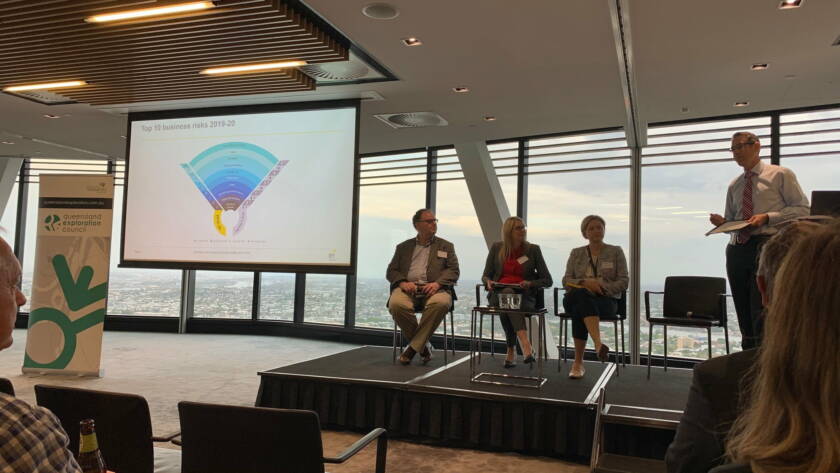
MEC’s Kylie Smith and Andrew Dittmann had the opportunity to attend an event hosted by the Queensland Exploration Council and Ernst & Young (EY) last week in Brisbane.
The event focused on the findings of Ernst & Young’s latest report “Top 10 Business Risks Facing Mining and Metals in 2019 -2020” and featured a panel discussion around the key talking topics of the report.
In an open cut mine, bulk dozer push can be one of the most cost-effective methods of moving overburden. Under the right application, the unit cost of dozer push sits somewhere between a dragline and truck/shovel excavation. So, if geotechnical conditions are favourable and the dozer fleet is sufficient, dozer push should be considered to replace some of the truck/shovel prime. Dozer push can also be used to replace dragline prime. This is because it can speed up the linear progression of the dragline - which in many cases will lower the dragline unit cost rate and increase coal uncovery.